Air vs sea freight china usa — which is right for your shipment? If you’re shipping from China to the USA, the first question most importers ask is: should I ship by air or by sea? The right answer depends on your cargo type, deadline, and budget.
This guide breaks down speed, cost, reliability, and cargo suitability — and gives you a clear decision framework so you don’t have to guess.
Quick Answer
表格
| If you need… | Ship by… |
|---|---|
| Delivery in 3–7 days | Air |
| Delivery in 25–40 days | Sea |
| Cargo under 100 kg or under $5,000 value | Air (often cheaper than you think) |
| Cargo over 500 kg or full container | Sea (much more cost-effective) |
| Perishable, urgent, high-value | Air |
| Heavy, bulky, non-urgent | Sea |
1. Speed: Air is Faster, But Time-to-Door Matters
Air freight transit time: 3–7 days from most Chinese airports (PVG, CAN, SZX, PEK) to major US airports (LAX, JFK, ORD, ATL).
Sea freight transit time:
- FCL (Full Container) : 25–35 days port-to-port
- LCL (Less than Container Load) : 30–40 days port-to-port
- Plus 5–10 days for trucking from port to your warehouse
But speed isn’t just transit time:
- Air freight goes through customs faster (usually 1–2 days)
- Sea freight customs clearance can take 3–7 days, especially during peak season
- Door-to-door, sea freight can take 35–50 days total — air freight typically 7–12 days
When speed matters most:
- New product launches
- Inventory stockouts
- Time-sensitive promotions
- Sample shipments
2. Cost: Sea is Cheaper for Volume, But Air Has Hidden Advantages
Rough cost ranges (China to USA, 2026) :
表格
| Route | Air (per kg) | Sea FCL (20ft) | Sea LCL (per CBM) |
|---|---|---|---|
| China → US West Coast | $4–8 | $2,500–4,500 | $80–150 |
| China → US East Coast | $5–9 | $3,500–6,000 | $100–200 |
Why air can be cheaper than you think for small shipments:
- A 50 kg shipment by air: roughly $200–400
- A 50 kg shipment by LCL: roughly $300–600 (minimum charges apply)
- Plus sea has extra fees: origin terminal, destination terminal, ISF, AMS, customs bond, drayage
For shipments under 100 kg, air is often the same price or cheaper than LCL — and arrives 4 weeks sooner.
3. Cargo Type: What Air and Sea Each Handle Best
Air freight is better for:
- Electronics, semiconductors, precision instruments
- Pharmaceuticals and medical devices
- Fashion samples and seasonal goods
- E-commerce (single SKUs to Amazon FBA)
- Perishable goods (with proper packaging)
- High-value goods (insurance costs are lower as % of value)
Sea freight is better for:
- Furniture and home goods
- Machinery and equipment
- Auto parts and components
- Apparel and footwear (large volumes)
- Non-perishable consumer goods
- Hazardous materials (sea has more flexible regulations)
Cargo limits:
- Air freight: typically max 500–1,000 kg per consignment
- Sea freight: no practical limit (FCL max ~28,000 kg per 20ft container)
4. Reliability: Sea Has More Variables, Air Has More Speed Buffers
Air freight reliability:
- Most delays are weather or customs related (usually 1–2 days)
- More frequent flights = more backup options
- Can re-route to alternate airports if needed
Sea freight reliability:
- Vessel delays common (1–2 weeks during peak season)
- Port congestion can extend transit time
- Container rollovers (booking accepted, container doesn’t load)
- Weather, strikes, peak season surcharges
For 2026 specifically:
- Red Sea disruptions are still affecting some Asia-Europe routes, but China-USA routes are unaffected (trans-Pacific)
- Hormuz-related issues (June 2026) impacted Middle East transit, but China-USA is still the most stable major trade lane
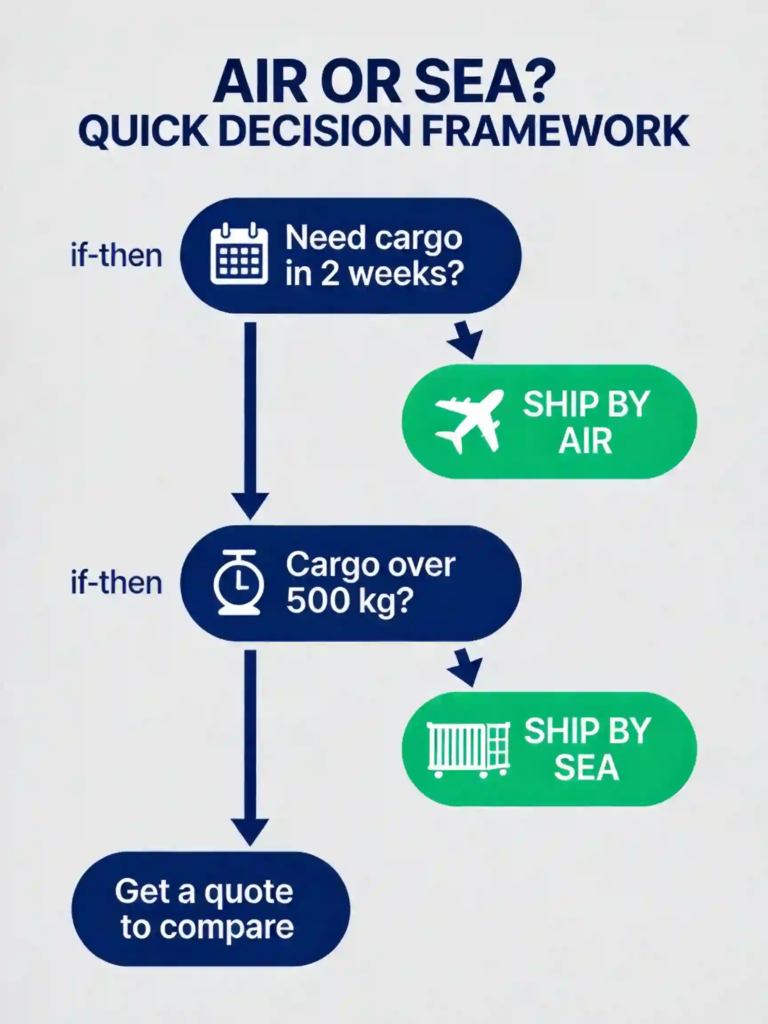
5. Decision Framework: How to Choose
Choose AIR if:
- ✅ Delivery deadline is within 2 weeks
- ✅ Cargo value is high (insurance + time savings justify cost)
- ✅ Cargo weight is under 500 kg
- ✅ Cargo is perishable, fragile, or time-sensitive
- ✅ You’re shipping samples or small batches
Choose SEA if:
- ✅ You can wait 30–45 days door-to-door
- ✅ Cargo weight is over 500 kg
- ✅ Cargo is heavy, bulky, or non-urgent
- ✅ You want the lowest cost per kg
- ✅ You can plan inventory 6–8 weeks ahead
Still unsure? Use this rule of thumb:
- Cost difference < 30% → choose air (faster, fewer variables)
- Cost difference > 50% → choose sea (savings outweigh time)
6. Hybrid Option: Sea-Air Combinations
For some shipments, you don’t have to pick one:
- Sea + air for samples: ship main inventory by sea, samples by air
- Sea + air for urgent replenishment: ship the bulk order by sea, urgent gap-fills by air
- Consolidation services: combine multiple LCL shipments and split between modes
Many freight forwarders (including us) can help you design hybrid routing — just ask.
FAQ: Air vs Sea Freight from China to USA
1. How much does air freight cost from China to USA?
Roughly $4–9 per kg depending on origin city, destination airport, and cargo weight. Minimum charges usually apply for shipments under 45 kg.
2. How long does sea freight take from China to USA?
FCL takes 25–35 days port-to-port. LCL takes 30–40 days port-to-port. Add 5–10 days for door-to-door delivery.
3. Can I ship perishable goods by air from China to USA?
Yes. Air freight handles perishables well, but you need proper packaging (temperature control, insulation) and documentation (phytosanitary certificates for some goods).
4. Is sea freight always cheaper than air freight?
For shipments over 500 kg, yes. For shipments under 100 kg, air is often the same price or cheaper than LCL when you factor in terminal fees and minimums.
5. What’s the most cost-effective option for 1,000 kg shipments?
It depends on the route and timing. Often sea LCL is cheapest, but air can be competitive for short timelines. Get a quote comparison from a freight forwarder.
6. How do I choose a reliable freight forwarder for China-USA shipping?
Look for: direct relationships with airlines/shipping lines (not just resellers), transparent pricing, customs brokerage in both countries, and experience with your cargo type.
Get a Free Quote
Not sure which mode fits your shipment? Send us your cargo details (weight, dimensions, commodity, deadline) and we’ll send back an air vs sea cost comparison within 1 business day.